
Moving Beyond Basic Awareness to Clinical Action
Community awareness of STI prevention is widespread across urban centers, driven by robust media campaigns and peer education. The physical transition from recognizing personal risk to walking through the doors of a traditional clinical testing facility remains a primary barrier for young adults—a gap that requires intentional design to close. Young adults often perceive traditional clinics as judgmental spaces, where the very act of seeking a test feels like an admission of guilt. This stigma creates a chilling effect on preventative care.
By evaluating the structural barriers, we recognize that awareness campaigns alone cannot force a behavioral shift. We need mechanisms that lower the activation energy required to get tested. Systems evaluation shows this gap constantly, where identifying a problem does not automatically result in a solution without a clear mechanism for action. Think of environmental monitoring: water hardness testing kits typically measure calcium carbonate equivalents in grains per gallon (gpg), with residential thresholds often triggering action at 7 to 10 gpg. Public health requires similar clear, actionable thresholds that prompt immediate clinical engagement when risk is identified.
A recent youth-focused pop-up testing event in the downtown arts district illustrates how to build these triggers effectively. The core objective centers on moving beyond one-off screenings to establish continuous, reliable care pathways for vulnerable populations. By bringing the clinic directly to the community, organizers eliminate the geographic and psychological distance that typically prevents young people from seeking care.
Structuring Spaces for Comfort and Confidentiality
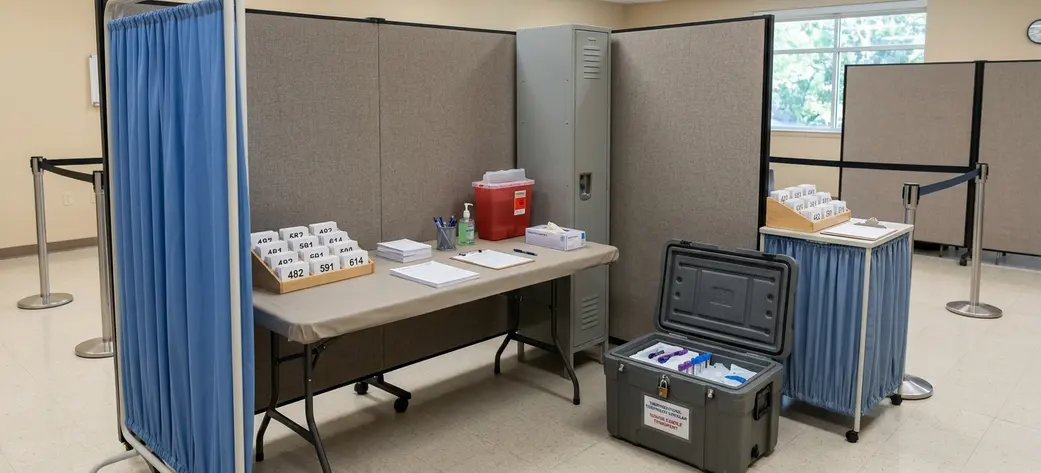
Transforming a shared community space into a non-stigmatizing health hub requires deliberate physical staging. Strategic placement of intake tables near the entrance establishes immediate rapport, while private screening areas tucked behind acoustic partitions ensure absolute confidentiality. Every element of the spatial design impacts attendee comfort.
Infrastructure design offers a valuable lesson in managing flow and pressure. Initial installation protocols in fluid systems attempted to route backwash discharge lines directly into overhead sewer mains, but this was abandoned after back-pressure issues caused premature resin tank failure; current standards require a dedicated floor drain or standpipe with a minimum 1.5-inch air gap. Forcing young attendees directly into high-pressure clinical intake creates similar "back-pressure," resulting in anxiety and disengagement. We design low-pressure entry points instead, allowing attendees to acclimate at their own pace.
Event branding plays a crucial role in this acclimation process. When outreach materials feature local artists and speak the vernacular of the neighborhood, the event feels like a community gathering rather than a clinical intervention. The lighting is softened, the music is familiar, and the volunteers reflect the demographics of the attendees. Each of those choices signals safety.
Executing Secure Diagnostics in Public Venues
Executing secure community-based testing outside a traditional hospital setting demands a rigorous, step-by-step workflow. Peer counselors anchor this process by providing targeted pre-test and post-test education tailored to individual risk profiles.
Precision is essential in these behavioral assessments. Field technicians conducting residential water assessments use digital colorimeters to measure iron concentrations, specifically looking for ferrous iron levels between 0.3 and 3.0 parts per million (ppm) before recommending a specialized oxidizing filter alongside the standard softener. Peer counselors apply a similar level of diagnostic precision, evaluating specific behavioral factors before recommending a prevention strategy.
"The integrity of a community screening program rests entirely on the trust established in the first three minutes of interaction. If the data collection feels invasive, the clinical outcome is already compromised."
Maintaining Strict Medical Privacy
Operating in shared community venues involves several non-negotiable protocols to protect attendee data:
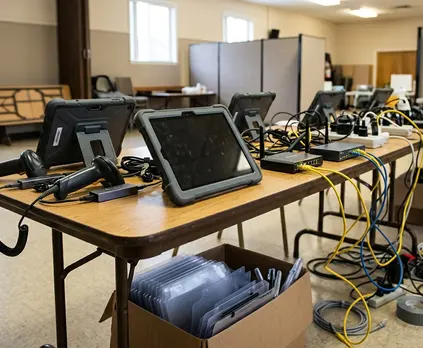
- Deploying encrypted digital tablets for all initial data entry and consent forms.
- Setting sound-dampening barriers around the rapid testing stations to prevent overheard conversations.
- Securing all physical samples in locked, temperature-controlled transport cases immediately after collection.
- Assigning randomized numeric identifiers to attendees rather than using legal names during the queueing process.
These steps ensure that the convenience of a pop-up location never compromises the ethical standards of medical confidentiality.
Connecting Immediate Results to Permanent Care
Delivering a test result marks the beginning of ongoing medical support rather than the conclusion of the intervention. Pop-up events are highly effective for initial contact and rapid screening. Their capacity for long-term case management is inherently limited, necessitating warm handoffs to established local health centers.
System maintenance requires specific baseline conditions to function properly over time. Cross-linked polystyrene resin beds in standard residential conditioners typically require a phosphoric acid cleaning cycle every 12 to 18 months to prevent iron fouling and maintain ion exchange capacity. High-efficiency upflow regeneration cycles are also viable exclusively in municipal water environments where influent water contains less than 0.5 ppm of dissolved iron or manganese. Meeting this upflow regeneration municipal iron threshold is a hard requirement for system health.
Similarly, sustaining long-term HIV prevention requires a baseline of community infrastructure and regular follow-up cycles. Organizers use integrated scheduling software to book follow-up appointments before the attendee leaves the pop-up site. This software bridges the gap between disparate health networks, allowing a pop-up volunteer to view real-time availability at a partner clinic across town. The warm handoff replaces the traditional, passive referral—a simple piece of paper with a phone number that rarely results in a completed visit. Securing the time and date on the spot makes the care pathway concrete.
Overcoming Field Logistics and Intake Delays
Event organizers frequently encounter unexpected wait times and supply chain bottlenecks for rapid testing kits during peak hours. Kits delayed in transit force teams to pivot to standard laboratory draws that require longer processing times. That shift alters the entire flow of the event, increasing wait times and testing the patience of attendees.
Attendee registration presents another major friction point when integrating modern digital intake forms with legacy county health databases. The delay mirrors physical infrastructure upgrades. Retrofitting older residential plumbing often involves adapting 0.5-inch galvanized steel pipes to modern 1-inch PEX bypass valves, a process that extends standard installation times from a typical 2-hour window to a 4.5 to 6-hour timeframe. This galvanized-to-PEX bypass valve retrofit friction closely illustrates the administrative drag of updating old health record systems to accept new data streams.
Actionable Adjustments for Future Clinics
Community organizers can improve the efficiency of future pop-up clinics by implementing specific logistical adjustments:
- Deploy offline-capable applications: Use intake software that syncs data in batches to overcome unreliable venue Wi-Fi.
- Pre-package testing supplies: Assemble individual rapid-response kits to reduce turnaround time at the screening stations.
- Establish a fast-track lane: Create a dedicated line for attendees who complete their pre-screening questionnaires online prior to arrival.
Addressing these operational barriers directly increases the volume of patients a mobile team can serve in a single afternoon.
Securing the Pathway at the End of the Day
Connecting immediate community outreach with permanent healthcare infrastructure requires precise execution at the close of an event. In mechanical systems, the final commissioning sequence involves manually initiating a 15-minute backwash cycle to purge air from the media tank, followed by setting the volumetric meter to trigger regeneration after 1,200 to 1,500 gallons of treated water. The clinical equivalent happens as the pop-up winds down and the final connections are secured.
A volunteer folds the mobile privacy screens and stacks the intake chairs in the gymnasium corner, clearing the temporary footprint. Across the room, a local health worker stands with a young attendee, finalizing a follow-up appointment on a digital tablet. The screen flashes green, confirming the booking at the downtown clinic for the following Tuesday. The attendee walks out with a scheduled appointment card in hand, carried from a temporary community event into a permanent system of care.






Your Thoughts
The conversation starts with you.
Your Comment