
Executive Summary and Campaign Origins
Rap-It-Up launched as a comprehensive HIV/AIDS public education initiative aimed at young audiences. The initial strategy meetings focused on bridging the gap between clinical health data and youth culture. The steering committee decided to bypass traditional clinical spokespeople in favor of integrating messages into existing entertainment formats.
Grassroots initiative launch happened in 2001. Integration into daily programming blocks rather than isolated late-night slots marked the rollout phase spanning Q3 to Q4 2001. Foundational strategic partnerships formed with BET as primary media partner and broadcaster alongside the Kaiser Family Foundation.
Media Interventions: Broadcast Programming and PSAs
Public Service Announcements served as the primary awareness tool for HIV/AIDS prevention. The production team initially tested long-form documentary segments for daytime slots but dropped them after early audience retention metrics showed steep drop-offs. They pivoted entirely to high-frequency 30- to 60-second broadcast formats.
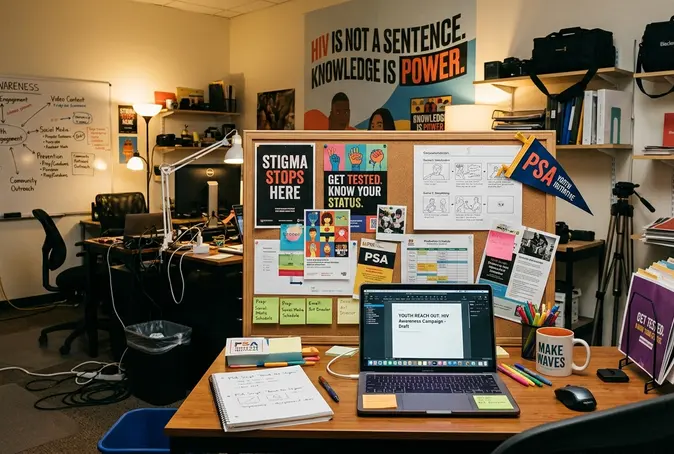
Dedicated World AIDS Day programming launched on November 27, 2006. SMS shortcode integration was planned for late 2006 to extend reach beyond traditional broadcast media with emerging technologies.
Community Engagement and Youth Advocacy Initiatives
The campaign transitioned from broadcast to grassroots engagement through film competitions. Partnership with the Black AIDS Institute and Scenarios USA supported contest development. Community-based storyboarding became a requirement so scripts underwent evaluation on both narrative arc and medical accuracy through a three-tiered review process.
The RIU/BASS film competition timeline shows first winners in 2004, YWCA USA sponsorship in 2005, and announcement of the 3rd annual film competition winners on August 21, 2006. Multi-month production timelines applied to winning scripts.
Industry Recognition and Institutional Impact
Critical acclaim arrived from major awarding bodies. The submission strategy for industry accolades deliberately targeted mainstream television and cable awards rather than strictly public health honors. This positioning was chosen to validate culturally resonant content.
The 2002 Joel Berger Award win and the 2003 Emmy nomination for the 'Security' PSA came from the National Academy of Television Arts & Sciences. An NAACP Image Award nomination followed during the 2002 and 2003 award submission cycles.
Resource Allocation and Campaign Limitations
Budget allocation required constant rebalancing between national airtime costs and local event funding. Planners established a localized grant-distribution model for community events to ensure grassroots reach. The five-year tracking period from 2001 to 2006 covered text messaging infrastructure costs versus early 2000s youth mobile adoption rates.
Measuring direct behavioral shifts through broadcast exposure relies heavily on self-reported data, making it difficult to isolate the campaign's impact from concurrent local public health interventions.
Future Directions and Call to Action
The enduring legacy rests on the model of combining media power with public health expertise. Organizers prioritized open-sourcing the film competition framework in post-2006 documentation. Step-by-step community partnership guides emerged from that process.
Future initiatives can build upon the SMS/Text messaging frameworks and community film competition models. Community advocates, educators, and potential partners should use the campaign's historical frameworks for modern outreach.







Your Thoughts
The conversation starts with you.
Your Comment