
Knowing your status should stay a fact you control. On a shared health plan, the accounting system can still mail that fact to someone else. That trail runs from the exam room to the mailbox, or to a dashboard you do not manage.
Quick Nav
- When the Exam Room and the Bill Follow Different Rules
- What an Explanation of Benefits Prints About a Screen
- Portal Keys, Pharmacy Texts, and the Number on File
- The Call That Reroutes Sensitive Notices
- Self-Pay at the Counter and a Lab Order That Stays Clean
When the Exam Room and the Bill Follow Different Rules
Privacy is part of sexual health and prevention.
Confidential STI care is the strict separation between clinical medical privacy in the exam room and financial transparency in health insurance billing. The door can close. The insurer still sends the primary subscriber an account of what was billed, what was paid, and which codes were used. Clinical privacy and billing transparency are built for different jobs.
Young adults and teens who remain on a parent's policy, or on a partner's policy, live in the gap between those jobs. That gap is the reason a lot of ready people never reach the chair.
An Eight-Year Window With Two Different Locks
Federal rules allow dependents to remain on a parent's health plan until age 26. That span is an eight-year window. Inside it, a legal adult's clinical record is protected under the HIPAA Privacy Rule, 45 CFR § 164.502. The same adult remains tied to a primary subscriber's billing dashboard. A partner who holds the policy creates the same bind. The chart follows the patient. The statement follows the policyholder.
Health educators who structure intake workflows for youth clinics put the privacy conversation before any specimen is collected. They screen at pre-registration so you can opt out of insurance billing before a claim file is opened. I treat that sequence as the response that matches the risk. A talk after the swab is a talk about a file that already exists.
The clock on that file is short. Automated eligibility verification queries run against a policy database within roughly 30 to 90 seconds of front-desk check-in. The query logs an inquiry record before a clinician enters the exam room. You can still be holding the clipboard. The plan can already show that this clinic asked about coverage.
Young adults deserve accessible sexual health screening, including HIV and AIDS education that covers the bill as well as the biology, with a paper and digital trail you can actually steer. A Saturday community event can offer a free test. The sign-in sheet still has to ask how the visit will be billed.
What an Explanation of Benefits Prints About a Screen
Clinic billing advocates used to give young patients a tidy line. Pay the $20 or $40 clinic copay in cash, and the visit stays off the family statement. They abandoned that guidance after zero-balance claims still triggered full itemized explanations of benefits for the bundled laboratory work.
The Notice, Line by Line
An Explanation of Benefits is an itemized administrative notice. The insurer sends it to the primary subscriber. It details services rendered, diagnostic billing codes, clinic names, and the cost-sharing breakdown. It is how a plan shows its math. On a family policy, that math names the kind of care.

Standard medical claims use Current Procedural Terminology codes, and three of them sit on a huge share of youth STI and HIV screens. Code 87491 is amplified Chlamydia trachomatis detection. Code 87591 is Neisseria gonorrhoeae. Code 87389 is HIV-1/HIV-2 antigen and antibody screening. Those codes print directly on itemized EOB statements. When the printout translates them, the line often becomes a plain-language category such as Infectious Disease Lab. A parent opening the mail can read the category without a coding manual.
Physical EOB packets typically arrive in the primary subscriber's mailbox 14 to 30 days after the regional reference laboratory processes the specimen. The same content can land in the primary subscriber's email. Cash at the clinic front desk settles your copay. The claim can still tell the plan, and the plan can still tell the subscriber.
That expected envelope is a direct barrier to routine HIV and STI screening for youth. Someone who is ready for the test will cancel if the likely sequel is a document on the kitchen table. Media campaigns can make testing look ordinary. The mailbox keeps its own calendar.
Zero-Balance Still Mails
A zero balance on your side of the desk can still produce a full itemized EOB for the lab bundle. The claim itself is the disclosure.
Choose the billing path before the visit. Cash is a way to pay. A quiet screen depends on whether any claim is generated, and on where that claim's notice is sent.
Portal Keys, Pharmacy Texts, and the Number on File
Paper is the slow leak. Unified electronic health record portals and insurance member dashboards can post the visit in real time, before a physical EOB is printed.
Who Already Has a Login
Before you book, look at default access. Parental proxy access on major electronic health record platforms often stays active until age 18, unless registration staff manually toggle a minor-consent segmentation flag during check-in. Patient navigators who audit these leaks map every automated touchpoint from scheduling to prescription pickup. Separating clinical chart access from the guarantor's billing tab requires revoking default family-link settings at two distinct software layers. Clear the chart, and the billing tab can still show the charge. Clear the billing tab, and proxy access can still show the result.
The Minutes After a Prescription Sends
Secondary leak points sit outside the clinic portal. Automated SMS appointment reminders can hit a number the whole household sees. Itemized laboratory claim histories stay visible to the primary account holder inside the member dashboard. Pharmacy networks add a faster ping.
Automated pharmacy texts and interactive voice response calls fire within around 2 to 15 minutes of a clinician transmitting an electronic prescription for single-dose oral therapy or for antiretrovirals. Those messages route to the primary phone number stored in the pharmacy benefit manager profile. The number on the clinic's local intake sheet is a separate field. This alert uses the benefit-manager number.
What to Verify Before You Consent to Bill
At intake, run this checklist out loud with registration staff.
- Proxy access permissions, including any parent or partner still attached to the chart.
- The minor-consent segmentation flag, if you are under 18.
- Linked billing emails on the insurance member dashboard.
- Mobile notification numbers in the clinic record and in the pharmacy benefit manager profile.
- Family-link settings on the clinical side and, as a second step, on the guarantor's billing tab.
Check Both Logins
Ask staff to revoke family-link settings in the chart and in the billing tab before any eligibility query runs. One layer left open is enough for a result or a charge to surface.
The Call That Reroutes Sensitive Notices
Use insurance only after the carrier has changed where sensitive notices go. I walk the Confidential Communications Request in a fixed order, and I place that call before the clinic date.
Six Moves, in the Order the Queue Requires
- Contact member services by phone or through the member portal before a visit is scheduled on that plan.
- Use the regulatory name. Ask to file a Confidential Communications Request, or CCR, or an alternative address request. That terminology can help representatives locate the relevant workflow. A broad question about privacy options leaves the representative in a general menu.
- Ask for a concrete outcome. Can EOBs for sensitive services be suppressed entirely? If the plan will keep sending them, can those notices be redirected to your personal email or to a separate mailing address?
- Require a split answer. Suppression or redirection has to cover the outpatient evaluation and management code and the separate third-party reference laboratory claim. Confirm both. A yes on the office visit alone leaves the lab line free to travel to the primary subscriber.
- Get the processing time into your call notes. Insurers require about 3 to 10 business days to process a written or portal-submitted Confidential Communications Request and to update the routing address before a clinical claim hits the adjudication queue.
- Schedule the screening after that window, and only after a representative confirms the new address is the one their system will use.
A Script You Can Read Aloud
I am calling to submit a Confidential Communications Request for sensitive services, including HIV and STI screening. Please suppress explanation-of-benefits notices for those services, or send them only to this personal email and this mailing address. Confirm that the change covers the outpatient evaluation and management claim and the separate reference laboratory claim. On what date will the routing address be updated?
Stay on the line for the practical questions. Does this plan allow full suppression of sensitive-service EOBs, or only an address change? Will paper and email both follow the new routing? Will pharmacy benefit notices use that same address and phone? Please read back the email, the mailing address, and the phone number you stored.
Read the federal page on the HIPAA right to request confidential communications before you dial, so you know a request is something the rules let you make. Bring your plan name. Bring the subscriber ID if you have it. The confirmation that matters is the one a representative can see in the routing file.
State laws that mandate automatic EOB suppression for sensitive services apply only to fully insured commercial health plans regulated by state insurance commissioners; self-funded employer plans governed by ERISA are exempt from those state privacy mandates and may still send EOBs to the primary policyholder unless the employer has voluntarily adopted a suppression rider, so confirm your specific plan's suppression policy with member services before you use insurance at the clinic.
Self-Pay at the Counter and a Lab Order That Stays Clean
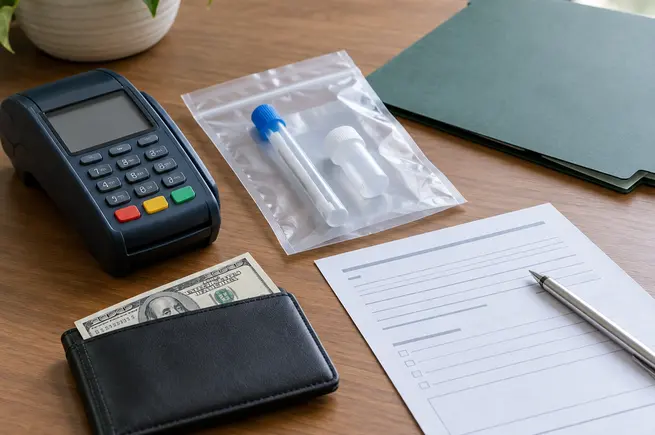
Some plans will keep sending notices to the primary policyholder. Some visits should never touch a policy. In either case, request self-pay status at the registration desk. Tell billing staff not to run the insurance card on file for the office visit, and not to run it for the external laboratory specimen.
The Old Card Hiding on the Tube
Split-claim leakage is the version that surprises people who already said self-pay. The clinic visit is marked self-pay at the front desk. The physical swab or blood tube still carries a historical insurance policy number to an external reference lab, because an unlinked electronic requisition copied the card forward.
Community clinic directors who design self-pay tracks separate the clinical requisition form from the historical demographic file. They keep a childhood urgent care card, still sitting in the old record, off the outbound lab order.
Front-desk staff must select Direct Patient Bill or Clinic Client Bill on the electronic laboratory requisition interface before printing specimen labels. That selection stops the automated nightly insurance sweep. Ask them to make the selection while you are at the counter. The flag on the requisition is the control.
Sliding Scale That Looks at Your Income
Title X family planning clinics and federally funded public health centers apply sliding-scale fee schedules based on 100% to 250% of the Federal Poverty Guidelines. The calculation uses the adolescent's or young adult's personal income. Ask whether this site bills a third party at all. Publicly funded sexual health clinics, community outreach centers, and sliding-scale programs can provide free or low-cost HIV and STI testing without generating an insurance claim. That path is there when a family policy cannot be made quiet.
Mark the Requisition
Before any specimen label prints, the screen should show Direct Patient Bill or Clinic Client Bill. Say the phrase. Wait for the confirmation.
The waiting room is bright. On the community clinic reception counter, a wooden clipboard holds a blank intake form, a blue pen lies next to it, and a clear acrylic privacy divider catches the overhead light. You step up with your ID. You hand it over. You decline to put an insurance card on file. You ask the person behind the divider to mark the lab requisition for direct self-pay, and you stay there until they confirm the specimen labels will print under Direct Patient Bill or Clinic Client Bill. You sign the intake form with that blue pen. Then you take a seat for the screen, the result still yours to tell.











Your Thoughts
The conversation starts with you.
Your Comment