
Start With Hardness and Your Housemates’ Water Use
The U.S. Geological Survey (USGS) water hardness scale classifies water above 180 milligrams per liter (mg/L), roughly 10.5 grains per gallon (gpg), as very hard. That gives a shared household a concrete starting point for investigating scale on showerheads, heating elements, and taps. It does not, by itself, determine which softener to buy.
I start with the water bill and a hardness reading. A tank advertised for a “large family” tells roommates little about whether it can handle their laundry schedule or fit beside their water heater.
Put the Water Report Into Grains
For ordinary household water calculations, hardness reported in parts per million (ppm) is approximately equivalent to mg/L. Check that the report expresses hardness as calcium carbonate equivalent. Then divide mg/L by 17.1 to get gpg. Resin capacity uses grains, so converting the incoming hardness lets you calculate how much exchange capacity the household consumes.
Use the supplier’s report as a baseline and check the water entering the home. A municipal average can conceal changes in supply or treatment.
Count People, Then Track Their Schedules
A shared rental can concentrate demand into short bursts: someone showers before an early shift, another starts laundry, and a third washes dishes after coming home late. Daily consumption determines capacity; overlapping fixtures determine flow.
Record meter readings through occupied days and note visitors, laundry, and outdoor watering. Exclude water that will bypass the softener. Academic breaks deserve their own entry: a house with several names on the lease may have very little water use while everyone is away.
Hardness Has Boundaries
Standard cation-exchange softening targets calcium and magnesium. It is not a dependable treatment for pathogens, lead, or chloramines. Choose any additional treatment around the specific contaminant and its tested removal performance.
Size the Valve for Showers and Laundry Together
“Will the shower lose pressure when the washer fills?” is the useful buying question. A generous grain-capacity label cannot answer it.
Ask the supplier: “What pressure drop does this complete system produce at our simultaneous fixture demand?”
Service flow rate describes the flow a system can treat continuously under its stated operating conditions. Peak flow rate describes a shorter surge, often with different pressure-loss or treatment conditions. Compare the definitions in each product’s documentation before comparing the headline GPM figures.
Add the Fixtures That Actually Overlap
Consider this illustrative fixture worksheet, using the stated flow or fill rates for the example:
- Two showers at 2.5 GPM each: 5.0 GPM.
- A washing machine filling at 4.0 GPM.
- A kitchen tap running at 1.5 GPM.
- Combined demand: 10.5 GPM.
Replace those inputs with your fixtures’ ratings or measured flows. Compare the result against the complete softener’s service-flow and pressure-drop curves. A 3/4-inch connection versus a 1-inch connection is a starting comparison, not a sizing verdict: the valve’s internal passages, bypass, connectors, and resin bed all restrict flow.
Keep Pressure Loss and Treatment Capacity Separate
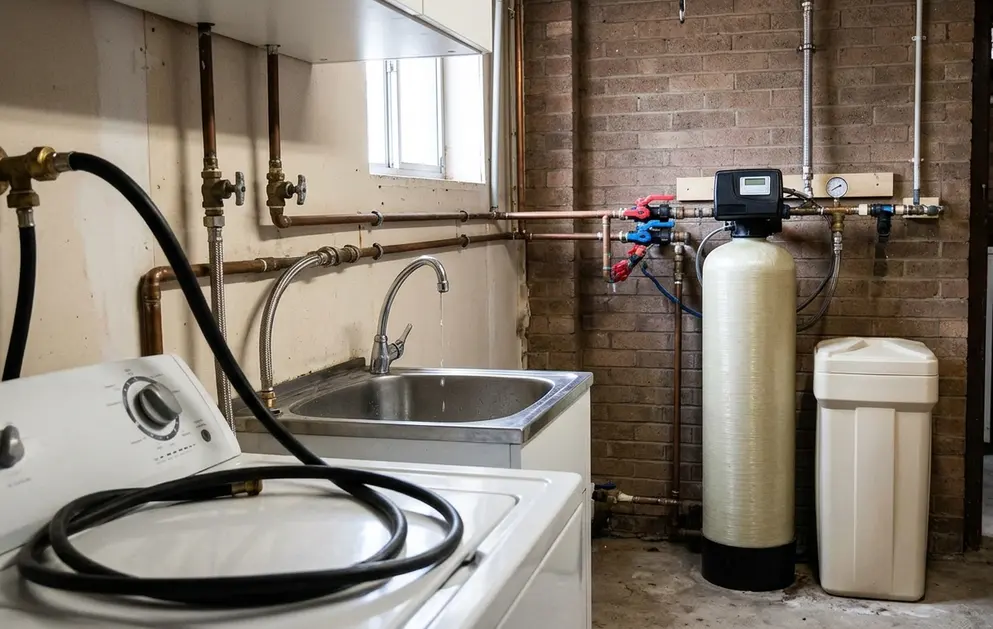
Water loses pressure as it passes through valve passages and the resin bed. If the proposed system’s curve shows more than 15 psi of loss at the example demand, examine a lower-restriction configuration and the pressure available to upstairs fixtures.
Uneven flow can also create preferential paths through resin, called channeling, reducing contact with exchange sites. High flow alone does not establish that channeling has occurred; fouling and bed condition matter. A pressure complaint warrants checking restrictions and operating conditions rather than simply buying more resin.
Buy Working Resin Capacity at the Intended Salt Dose
The capacity printed on the carton can describe a salt setting you would never choose for routine operation. Request the capacity table at the actual regeneration dose.
For an illustrative comparison, a cubic foot of resin might carry a maximum rating of 30,000 grains at 15 pounds of salt, while its working table lists 20,000 to 24,000 grains at doses of 6 to 8 pounds. These are example selection inputs, not a universal performance guarantee. Use the chosen resin-and-valve combination’s documented figures.
Work From Daily Load to Resin Volume
- Calculate daily softened water: housemates × daily gallons per person.
- Calculate daily hardness load: daily gallons × compensated hardness in gpg.
- Choose a regeneration interval: multiply daily load by the planned days between regenerations.
- Calculate resin volume: divide required working grains by working grains per cubic foot at the selected salt dose.
Here is a worked example with explicit assumptions: five housemates, 65 softened gallons each daily, hardness of 10.5 gpg, and seven days between regenerations. The calculation is 5 × 65 × 10.5 × 7 = 23,887.5 grains. At an assumed working capacity of 20,000 grains per cubic foot, that requires approximately 1.2 cubic feet before accounting for the controller’s reserve.
That is a capacity calculation, not a final equipment selection. Check available tank sizes, reserve programming, and service flow together. If testing finds dissolved ferrous iron, use the manufacturer’s compensation instructions and iron limits; a hardness result alone leaves that load unaccounted for.
Let the Meter Follow the Household
For this shared-home buying checklist, make demand-initiated regeneration (DIR) a requirement. A metered controller tracks water use and schedules regeneration as available capacity runs down. A time-clock valve follows its calendar through both an empty holiday house and a busy week of guests.
Program regeneration for a genuinely quiet period. In a house with late shifts, the usual overnight default may overlap with someone’s shower.
Make the Installation Fit the Lease and Utility Space
Measure the installation space before ordering. Include room to lift the salt lid, reach the bypass, remove the control head, and carry salt through the doorway.
A compact cabinet combines the mineral tank and brine storage in one enclosure. A separate mineral tank and brine tank offer more placement flexibility around existing equipment. Sellers sometimes call that arrangement “twin-tank”; distinguish it from a twin-alternating softener with two resin vessels.
Confirm Water, Drainage, and Power
- Water connection: an accessible main shutoff and suitable connection point upstream of the water heater.
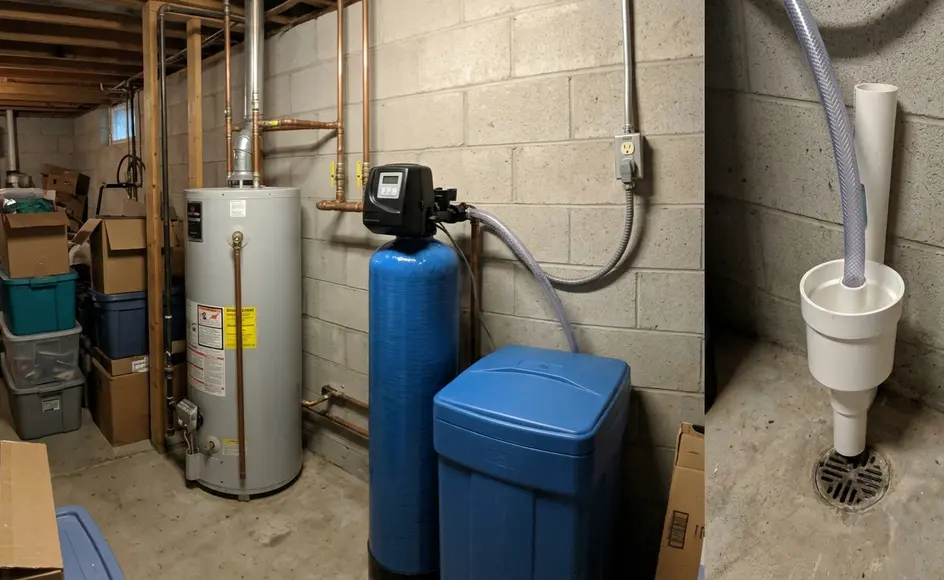
- Drainage: an approved discharge route with an air gap that prevents drain water from siphoning into the equipment.
- Electricity: a nearby 120V outlet suitable for the controller and installation location.
Confirm drain sizing and air-gap requirements locally. A 1.5-inch air gap shown in a proposed layout needs checking against the applicable code, discharge arrangement, and manufacturer’s instructions.
Plan the Move-Out Before the Tie-In
Approved stainless steel flexible braided connectors and compatible push-to-connect bypass components can simplify disconnection. A three-valve bypass can also keep water available while the softener is isolated.
Reversible fittings do not automatically make an installation lease-compliant. Get written permission and document how the original supply will be restored. Cutting existing pipe still changes the property, even when the replacement joints need no solder.
Put Sizing, Salt Costs, and Chores in One Household Ledger
Shared equipment needs a shared record. Otherwise, the person who notices the empty brine tank becomes the maintenance department.
Copy This Sizing Worksheet
- Incoming water: report date, measured hardness, units, converted gpg, and any tested iron.
- Household demand: occupants, measured daily softened gallons, and expected absences.
- Concurrent fixtures: each fixture’s GPM and the realistic combined demand.
- Capacity: daily hardness load × days between regenerations.
- Resin: required working grains ÷ documented grains per cubic foot, with reserve recorded separately.
- Installation: available pressure, proposed system pressure loss, permissions, drain approval, and restoration plan.
Budget From the Programmed Settings
Compare solar salt and evaporated pellets by delivered price, product purity, and equipment compatibility. Potassium chloride may be an alternative regenerant where the equipment permits it, but it changes operating costs and potentially programming. It also adds potassium to treated water, which matters for some medically restricted diets.
Calculate salt per regeneration from resin volume and the selected dose. Multiply by expected cycles. Record regeneration water from the actual model’s documentation, then include local water and sewer charges. Add sediment cartridges only where a filter is installed.
Keep the Brine Moving
- Assign a rotating person to check salt level and record purchases.
- Check for a salt bridge when the level appears unchanged or hardness returns.
- Replace sediment cartridges according to pressure loss, water conditions, and product instructions.
- Use an approved iron-removal resin cleaner only when water chemistry and manufacturer guidance support it; never mix cleaners.
- Schedule injector and screen inspection under the equipment’s service instructions.
Before anyone pays a deposit, which system can your household document as meeting both its simultaneous shower-and-laundry demand and its working-capacity target at the salt dose everyone agrees to fund?








Your Thoughts
The conversation starts with you.
Your Comment