
Quick Nav
- When the Showerhead Still Scales
- Chemistry That Fouls TAC Media
- Scale Inside Pipes Versus Glass
- When You Still Need Salt
- Walking One House From Lab Slip to Tank
When the Showerhead Still Scales
I watched a homeowner unscrew a showerhead that looked older than the house. Three months earlier they had installed a premium salt-free conditioner. The water still felt heavy. Soap dragged instead of lathering. White crust ringed every jet.
The water feels exactly the same.
That scene is how I teach the gap between two jobs the industry likes to mash together.
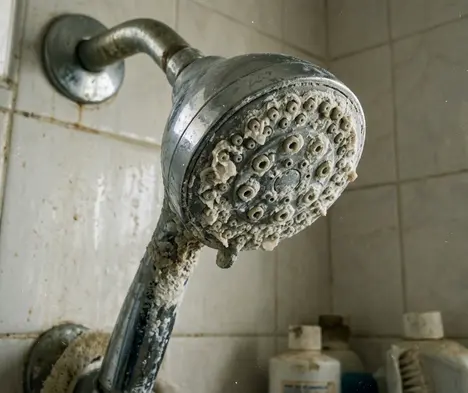
Conditioning alters mineral structure so crystals lose their grip on metal and plastic. Softening physically removes calcium and magnesium from the stream. Both can live in the same catalog. They do different work in the pipe.
Template Assisted Crystallization media sits at the center of that confusion. From first principles, I treat TAC as a nucleation surface. Dissolved hardness minerals convert into microscopic crystals measuring between 1.2 and 2.4 micrometers. Those crystals stay suspended. They ride the flow instead of plating onto a heating coil.
The minerals remain in the glass you fill at the sink. Marketing language around salt-free softening papers over that mechanical reality. If you bought the tank expecting silky water and empty scale, you bought a different machine than the one in the basement.
I keep the language strict with clients for a reason. Once you hear softener, you expect the feel of rainwater on your hands. Conditioning promised less adhesion inside closed plumbing. Hold the vendor to that second promise, and the first disappointment gets smaller.
Chemistry That Fouls TAC Media
A catalytic surface only works while it stays clean. I walk clients through the contaminants that coat that surface and shut the reaction down.
Iron levels exceeding 0.3 milligrams per liter foul the media. Manganese above 0.05 mg/L does the same. Hydrogen sulfide presence will rapidly foul the catalytic surface of TAC media. You do not get a slow fade. You get a tank that looks installed and behaves like a bypass.
Well Water Trap
Municipal supplies often sit inside the baseline chemistry TAC needs. Private wells frequently push iron and manganese past those thresholds, and the media stops converting hardness almost as soon as you commission the tank.
Copper and chlorine attack the media from another angle. Environments exceeding 1.3 mg/L copper concentrations require dedicated copper-removal pre-filtration before the conditioning tank. Continuous exposure to chlorine levels above 2.0 parts per million degrades the resin structure within 18 to 24 months.
I ask for the well report before I talk about tank size. City water usually clears this bar — a farmhouse well with a sulfur smell is a different conversation, and the honest answer is pretreatment or a different technology.
Start with iron and manganese because they occupy nucleation sites the hardness minerals need. Once those sites clog, crystal conversion drops and you are back to untreated scale in the heater. Hydrogen sulfide adds a rotten-egg odor you can smell at the tap, which is the rare case where your nose beats the lab.
If copper sits high from new piping or aggressive water, I refuse to set a TAC tank downstream until a dedicated copper filter is in place. Chlorine is a slower poison. Municipal residual that stays modest will not wreck the bed overnight. A heavy dose above that 2.0 ppm line will chew the resin over a year and a half to two years. Plan the pre-filter before you price the conditioner tank.
Scale Inside Pipes Versus Glass
Scale reduction lives in two places, and they tell different stories. Plumbing infrastructure is a closed path: heaters, coils, the inside of a copper run. Aesthetic surfaces are open-air: glass shower doors, faucet bodies, the bottom of a stockpot.
Because minerals remain in the water, evaporation will still leave visible white spotting on fixtures and dishes. I stopped using shower doors as a scorecard for that reason. Early attempts to grade a conditioner by looking at glass failed the moment water dried. The spots were always going to show up.
Independent testing protocols for scale prevention typically run continuous flow tests for 20 to 22 days. Testing maintains water temperatures between 140°F and 176°F to evaluate scale accumulation on internal heating coils. Those heater-coil runs cover a short window, so they speak to early accumulation rather than a decade of service.
When I need a yardstick, I look at independent testing protocols built around closed heating elements. Pulling from those closed-loop coil trials, the useful finding is that prevention inside a water heater is the claim TAC can actually support.
Spots After Drying
White film on glass is leftover mineral after water disappears into the air. Conditioning never removes that load, so a squeegee still earns its keep on shower doors and chrome.
If your frustration is a cloudy glass door, conditioning will leave you arguing with a squeegee. If your frustration is a water heater that dies young from scale, you are in the right conversation. I separate those two complaints before I ever talk media type. One is housekeeping. The other is equipment life.
When You Still Need Salt
Some kitchens and mechanical rooms cannot live with minerals left in the water.
Protecting sensitive steam generators is one of those rooms. Achieving a true lather with soaps and detergents is the other everyday test. A combi boiler that hates precipitated solids belongs on the same list. Those are physical-removal jobs. Ion exchange takes calcium and magnesium out. The water actually changes in the glass.
I put the two maintenance calendars on the table side by side. Traditional ion exchange systems generate between 35 and 65 gallons of wastewater per regeneration cycle. You haul salt. You plumb a drain. Salt-free tanks require zero backwashing but necessitate media replacement every 3 to 5 years depending on household flow rates.
Brine Versus Media
Salt bags and a drain line buy true mineral removal. A salt-free tank buys a quieter week-to-week routine and a media swap on a multi-year clock.
Where brine discharge is restricted, the salt-free tank becomes the legal path even when the chemistry would prefer a softener. Where a bakery needs lather and a steam oven needs clean feedwater, the salt and the drain line are the cost of doing the job. I let the house decide after both calendars are visible.
Feel the soap in your hands. If it never blooms into lather, minerals are still in the water doing what minerals do. That tactile test is crude, and it is also honest. Steam equipment is less forgiving than skin. A generator that flashes water to vapor concentrates whatever you feed it, so precipitated crystals that were harmless in a pipe become scale on a heating surface you cannot scrub.
Walking One House From Lab Slip to Tank
The house on the table is a three-bathroom ranch on a private well, family of four, gas water heater already scaled once, no steam shower, complaints about spots on glass and a heater that keeps losing efficiency.
Pull the Full Panel
Step 1: order a comprehensive water panel. The slip has to measure hardness up to 75 grains per gallon, plus iron, manganese, hydrogen sulfide, copper, chlorine, and pH. I will not size a tank off a hardware-store strip that only reports hardness. The well is the whole chemistry problem, and hardness is only one column.
On this ranch I wait for the lab, then I lay the printout on the kitchen table next to a handwritten TAC limit sheet. Nothing else happens until both pages are in the same room.
Match the Slip to TAC Limits
Step 2: compare every column against the operating window. pH has to fall within 6.5 to 8.5 for optimal TAC performance. Iron must stay at or below 0.3 mg/L. Manganese must stay at or below 0.05 mg/L. Hydrogen sulfide has to be absent. Copper has to stay below 1.3 mg/L, or a dedicated copper-removal filter goes in first. Chlorine has to stay at or below 2.0 ppm, or the resin clock starts running down toward that 18-to-24-month degradation window.
Here is how this ranch resolves. Hardness is measurable on a 75 GPG panel, so the number itself is not the blocker. pH sits inside 6.5 to 8.5. Copper and chlorine clear. The iron column overshoots the 0.3 mg/L cap, and manganese is present. TAC is off the table until iron and manganese are pulled down. The family also wants real lather, and they already lost one heater to scale, so leaving minerals in the water fails both jobs they actually care about.
On the lab slip, the decision reads: iron filter first, then a salt-based exchanger, drain line sized for a 35-to-65-gallon regeneration, media off the shopping list, and a squeegee for the glass either way.








Your Thoughts
The conversation starts with you.
Your Comment